Once I began college I realized that I needed eyeglasses (spectacles) to get the needed notes within auditorium type classrooms. I knew for sometime that I needed glasses, but denial of my failing eyesight prevented me from visiting the optometrist. It wasn't popular culture that prevented me from getting eyeglasses, but the fact that I wanted to be the only brother without corrective lenses. Once I visited my optometrist I learned that I was nearsighted and needed corrective lenses to focus on far away objects.
Vision problems plague 60% of the population in the United States. Many vision problems like myopia, hyperopia, astigmatism, and presbyopia can be prevented with the use of corrective lenses. Through mainstream media eyeglasses were seen as the iconic symbol for the nerd, as with Steve Urkle, Peter Parker, and Leonard. The 21st century has changed the iconic symbol to a fashion statement in which many people wear glasses that don't require a prescription.
 Fraser Eye Care Center: Myopia, Hyperopia, Astigmatism, & Presbyopia
Myopia (Nearsightedness):
Fraser Eye Care Center: Myopia, Hyperopia, Astigmatism, & Presbyopia
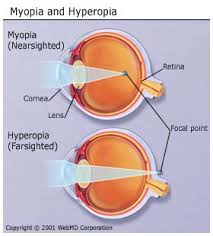
Myopia (Nearsightedness): An individual is able to see objects up close, but is unable to focus on far objects. The shape of the eye is elongated compared to a normal eye.
Hyperopia (Farsightedness): An individual is able to see objects far away, but is unable to focus on near objects. The shape of the eye is shorter compared to a normal eye.
Astigmatism: An individual has blurred vision due to the cornea or lens is irregularly shaped which causes refraction problems.
Presbyopia: As individuals reach of age of 40 the supporting structures of the lens wear down, which causes similar symptoms of a farsighted individual.
CDC: National Data Vision Statistics - If you click on the National Eye Institute/Statistics and Data website it will give you charts and tables that describe vision problems from 200 to 2010.
CDC: West Virginia Vision Statistics - This site does contains the same information but focuses on 2007 West Virginia data.
Research:
Using the information that you have learned about the eye and the disorders that can affect the eye, you will need research corrective lenses and statistical data for nearsightedness and farsightedness. You will need to create a presentation (power point, prezi, and others) that covers the checklist.
- Presentation
- Minimum of eight slides
- Include pictures or video
- Slide etiquette: use pictures, limited wording, title for each slide, able to read
- Last slide is bibliography (MLA format)
- Content
- Describe nearsightedness and farsightedness and provide an example
- Describe the corrective lenses need to fix farsightedness and nearsightedness
- Provide statistical data for vision problems
 It's amazing that the precursor of contact lenses began with Leonardo da Vinci making an observation about improved vision under water, which eventually led a German ophthalmologist to come up with glass contacts. Adolf Fick was the first person to successfully produce and fit a pair of glass contact lenses into rabbits eyes. There were some glitches to glass contacts: uncomfortable to wear, could barely blink, and it produced a dry eye which impaired vision. These glass spheres were the precursor to plastic contact that are used in the 20th and 21st centuries. If it were not for glass we wouldn't have improved optics that we have today, whether that be contacts, eye glasses, or interocular lenses.
